
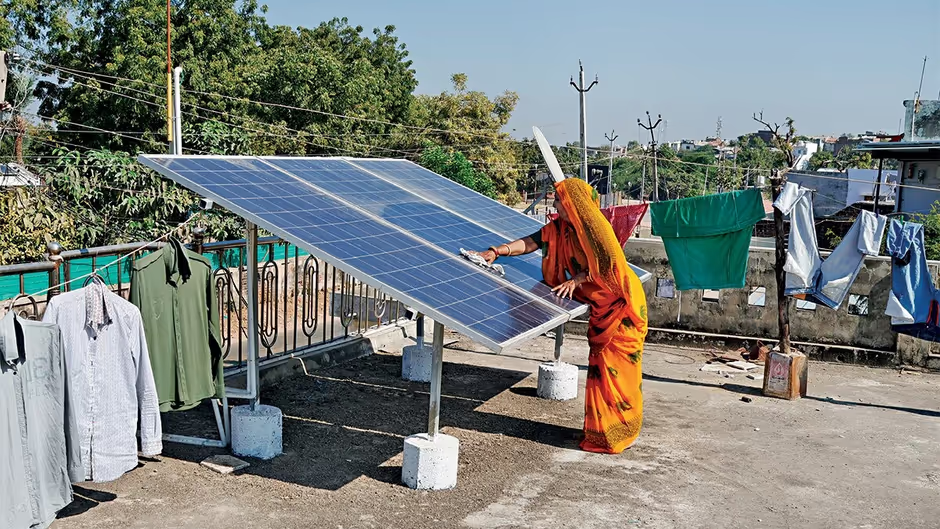
Is India lighting up its future or quietly adding to its financial burden, rooftop by rooftop?
The question has gained urgency with the launch of the PM Surya Ghar Yojana in 2024 by the Indian government to promote the installation of rooftop solar plants.
The scheme is ambitious, with a budget outlay of more than ₹75,000 crore and an aim of providing electricity to 1 crore households. The more important question is not whether it is feasible, because it clearly is, but why rooftop solar has not scaled without state support.
From Monthly Bills to Long-Term Assets
Rooftop solar technology is different from other electricity generation technologies, as it turns households into producers by enabling them to trap sunlight and convert it into usable energy.
Under the scheme, households can avail subsidies of up to 60% for small systems, bringing down the initial cost significantly. The government estimates that households can save ₹15,000 to ₹18,000 annually on electricity bills. But for many, the ability to pay even the subsidised initial investment remains a challenge. Data from the Ministry of New and Renewable Energy (MNRE) shows that the adoption of rooftop solar in India has been primarily in urban, high-income households, with states such as Gujarat and Maharashtra leading in terms of the number of installations. This leads to a distributional challenge: the scheme may disproportionately benefit those who can invest, not those who are the most burdened by electricity costs.
Catalyst or Crutch?
In the past, the Indian rooftop solar industry has been highly dependent on subsidies, including capital subsidies from MNRE. These efforts have been helpful in jump-starting adoption, but have not been enough to sustain momentum. The PM Surya Ghar Yojana aims to address these issues through subsidies along with simple application processes and direct benefit transfers. Such targeted interventions could help overcome initial barriers and build confidence in the market.
But extending reliance on subsidies carries risk, as they can distort prices and undermine innovations in new financing structures, such as leasing or pay-as-you-go mechanisms. The scheme’s success, therefore, depends on whether it can move from subsidy-driven growth to market-driven expansion.
The Adoption Gap Isn’t Accidental
India’s rooftop solar capacity, around 11 to 12 GW as of 2024, falls significantly short of earlier targets of 40 GW, highlighting persistent adoption challenges.
According to reports from the Central Electricity Authority and MNRE, there are several problems, including limited consumer awareness, delays in net metering approvals, and the weak financial health of DISCOMs (Electricity distribution companies that supply power to consumers at the state level), which often have little incentive to promote decentralised generation.
Access to affordable financing also remains a constraint, especially for middle-income households, indicating that low adoption is not due to a lack of profitability, but due to systemic inefficiencies and institutional barriers.
Spending Choices Matter
The fiscal scale of the scheme inevitably raises questions about the opportunity cost. Could the same resources yield greater impact if directed toward grid-scale solar, battery storage, or DISCOM reforms?
Large solar parks in India already produce some of the world’s cheapest electricity, often below ₹2.5 per unit, and rooftop solar offers distinct advantages: reduced transmission losses, lower peak demand, and greater energy independence for households.
Public spending on energy is not just about cost minimisation but also about long-term system stability and risk diversification, as suggested by the Reserve Bank of India’s discussions on green finance.
Conclusion
The PM Surya Ghar Yojana can be viewed less as a fiscal burden and more as a strategic intervention in a market that has struggled to scale on its own. But its long-term success depends on careful design. Subsidies must remain targeted and time-bound, complemented by reforms in DISCOM incentives, easier access to credit, and streamlined regulatory processes.
In the end, the real test of the scheme is not how many households install solar panels today, but whether it creates a self-sustaining ecosystem where subsidies become unnecessary. If it succeeds, it will not just expand solar capacity; it will fundamentally reshape how Indian households participate in the energy economy.
Citations:
Recent Comments