
Introduction
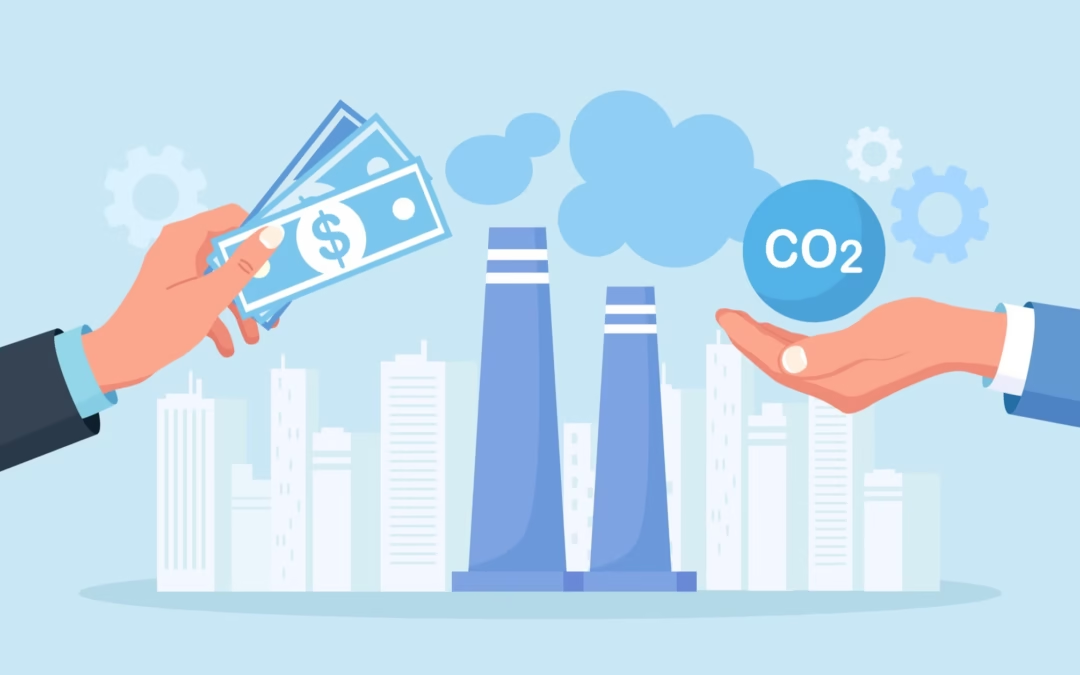
Carbon pricing is a policy tool that assigns a monetary cost to greenhouse gas emissions. By putting a price on carbon, individuals and companies are incentivised to reduce their emissions. The main idea of carbon pricing is to make the people who pollute pay for the damage they cause, such as health problems, damage to property and crops. This helps companies and individuals reduce the amount of carbon dioxide they release. They can do this by using cleaner energy sources and investing in new technology that releases less carbon dioxide.
There are two main ways to make companies pay for their carbon emissions. One way is to charge them a tax on the carbon dioxide they release. The other approach is to set a limit on the total amount of carbon dioxide companies can release and issue pollution permits (also called emission allowances). Each permit allows a company to emit a specific amount of CO₂, such as one ton. Companies that emit less than their limit can sell their unused permits to other companies that need to emit more, creating a market where these permits are bought and sold. A carbon tax is like a fixed fee that companies have to pay for every ton of carbon dioxide they release. This way, companies know how much they will have to pay. However, it is uncertain whether this will significantly reduce emissions. The other system, called a cap-and-trade system, sets a limit on the amount of carbon dioxide that can be released.
Identified Key Problems
It is not easy to put carbon pricing into action, such as carbon taxes or systems for trading carbon dioxide emissions.
A major concern is that carbon taxes affect people with lower incomes more because they spend a bigger part of their income on energy. This is a problem of fairness and how the costs are shared.
Companies that have to pay for carbon pricing may have to pay more to produce things than companies in places that do not have carbon pricing. This can hurt the goals for reducing carbon dioxide and make it harder for local companies to compete. If the price placed on carbon dioxide emissions is set too low or fluctuates too much, companies may not feel enough financial pressure to reduce their emissions, which reduces the effectiveness of the carbon pricing system. The price of allowances to release carbon dioxide in the trading system can be too unpredictable or too low to encourage companies to invest in ways that reduce carbon dioxide emissions. If the system is not designed well or if there are many rules, it can distort the prices.
The fact that carbon pricing is different in parts of the world creates problems.
Recommendations
1. Enhance Price Signals
Carbon price levels must be stable and sufficiently high to reduce emissions. ETS markets can reduce volatility through measures like price floors and ceilings, enabling more predictable long-term investment in clean technologies. In the EU ETS, there is the proposal of a “price corridor” to prevent extreme peaks and dips, which would undermine effectiveness.
2. Revenue recycling and equity measures
To mitigate regressive impacts, revenues should be redistributed through revenue recycling or strategic investments that benefit vulnerable groups. There are both carbon dividends whereby revenues are returned equally to people to help offset higher energy costs for low-income households, as well as targeted rebates or tax cuts to offset communities affected.
3. Changes To Borders
CBAMs can tackle competitiveness issues and leakage by putting all imported goods on equal footing in terms of carbon costs. As a result, domestic producers are not put at a disadvantage relative to foreign firms, which do not incur similar carbon costs. The usage of the carbon border adjustment mechanism (CBAM) by the European Union (EU) is showing how trade-related.
4. Expand Coverage
The environmental effectiveness of pricing mechanisms improves when expansion to sectors and gases occurs. Carbon pricing should cover major sources such as transport, buildings, and industrial CO₂ emissions. More investors can enhance market liquidity in ETS regimes.
5. Policies That Complement Each Other
Carbon pricing should be complemented with renewable energy support, energy efficiency standards, low-carbon infrastructure investment and other climate policy instruments. The price of carbon must be designed to complement other tools to facilitate decarbonization without creating a shock to economic systems. Utilising two or more policy tools is frequently less costly than one.
6. International Collaboration and Market Integration
By coordinating internationally and linking carbon markets, efficiency is enhanced, price fragmentation is reduced, and the carbon market is larger and more stable. Efforts to create coalitions relating to ETS would expand coverage, reduce emissions leakage and harmonise systems across borders.
7. Clear Metrics and Enforcement
Effective carbon pricing ensures effective monitoring systems. The consistency of measures and fairness in application creates market integrity and confidence in the marketplace.
Implementing these recommendations can improve the equity, effectiveness, and credibility of carbon pricing.
Effects on policy
1. Economic Choices
Although carbon pricing helps the environment, it comes with economic costs. Greater costs of energy; direct impacts on GDP and IR capacity in the short run; particularly in energy-intensive sectors like steel and cement, could happen in future. Climate change is going to have an impact on our lives if we do not do something about it. The effects of climate change will be very bad for the economy. Climate change is a problem that we need to deal with. We have to make sure that we are taking care of the economy at the same time.
Policymakers have a job because they have to balance climate change and the economy. They need to find a way to make sure we are protecting the environment and also making sure people have jobs and the economy is doing well. Climate change and the economy are two important things that we need to think about.
Policymakers can use revenues generated from climate policies to support industries during the transition to a low-carbon economy. These funds can also be invested in training and reskilling programs that help workers from carbon-intensive industries move into new sectors and employment opportunities. Such measures ensure that climate action does not come at the expense of economic stability. By balancing environmental goals with economic considerations, governments can work toward reducing emissions while maintaining a strong and resilient economy.
2. Rivalry and Global Collaboration
If one country unilaterally prices carbon, then its domestic industries will be at a cost disadvantage to firms in countries without such pricing. They can facilitate the parsimonious achievement of their respective climate goals.
3. Equitable Human Rights in Health & Social Development
If not designed thoughtfully, carbon pricing can increase inequality by lifting energy prices, especially for poorer households. This suggests that redistributive measures to mitigate the impact on the poor may take the form of carbon dividends and rebates.
The Just Transition Framework is really important to make sure workers and communities who are affected by the transition to low-carbon economies have equally attractive opportunities, are protected, and can learn new skills. If we think about fairness when we make plans for carbon pricing, it will be more acceptable to people and will be the right thing to do.
4. Long term policy certainty
We should have a predictable price for carbon, which will make businesses feel more confident and want to invest in things that are good for the environment. If the price of carbon is not clear or keeps changing, businesses will not want to invest in low-carbon products. To help businesses plan for the long term, policymakers need to make a carbon pricing plan that is predictable, like having a minimum price or a range of prices or using a mix of taxes and trading. The way we price carbon affects a lot of things, and not just the amount of emissions we produce. It also affects how well our economy does, if things are fair for everyone, how well we work with countries and how fast we can switch to net-zero emissions.
Carbon pricing has some problems. Many carbon prices are too low to help us reach our zero targets. When we look at how carbon pricing is set up we can see that it has some flaws. For example, some markets give out many permits, which makes carbon pricing less effective.
Studies have shown that carbon pricing can hurt low-income households, too. This is because carbon pricing can make things more expensive for people who do not have a lot of money.. If we take the money from carbon pricing and give it back to people who need it, then it can be more fair.
We know that carbon pricing is a way to reduce emissions. We also know that it needs to be part of a bigger plan. We need to make sure that carbon pricing is working well with policies.
Conclusion
Carbon pricing is an important tool when we are trying to stop climate change. This is because it makes people and companies pay for what they do to the environment. We have seen that carbon pricing can actually reduce emissions. It only really works if the carbon pricing is designed properly. We also need to make sure that carbon pricing is fair and that it does not hurt some people disproportionately. We need to make some changes to carbon pricing. We need to make sure that the carbon pricing is stable and that it is high enough to make a difference. We also need to help people who are hurt by carbon pricing. We need to work with countries to make sure that we are all doing the same thing with carbon pricing. If we do all of these things, then carbon pricing can be a powerful tool in our fight against climate change.
References
Hafstead, M. (2022). Carbon pricing 101. Resources for the Future. https://www.rff.org/publications/explainers/carbon-pricing-101/
Haites, E. (2018). Carbon taxes and greenhouse gas emissions trading systems: What have we learned? Climate Policy, 18(8), 955–966. https://doi.org/10.1080/14693062.2018.1492897
Metcalf, G. E. (2019). Cap and trade: The other way to price pollution. In Paying for pollution: Why a carbon tax is good for America (pp. 73–86). Oxford University Press.
Tsai, W.-H. (2020). Carbon emission reduction—Carbon tax, carbon trading, and carbon offset. Energies, 13(22), 6128. https://doi.org/10.3390/en13226128
Frank, C. (2014). Pricing carbon: A carbon tax or cap-and-trade? Brookings Institution. https://www.brookings.edu/articles/pricing-carbon-a-carbon-tax-or-cap-and-trade/
Xu, J. (2024). The role of carbon pricing in food inflation: Evidence from Canadian provinces. arXiv. https://arxiv.org/abs/2404.09467
Crépey, S., Drapeau, S., & Tadese, M. (2025). Comparison of tax and cap-and-trade carbon pricing schemes. arXiv. https://arxiv.org/abs/2510.15941
Linden, J., O’Donoghue, C., & Sologon, D. (2026). Modelling distributional impacts of carbon taxation: A systematic review and meta-analysis. arXiv. https://arxiv.org/abs/2601.07713
Recent Comments